


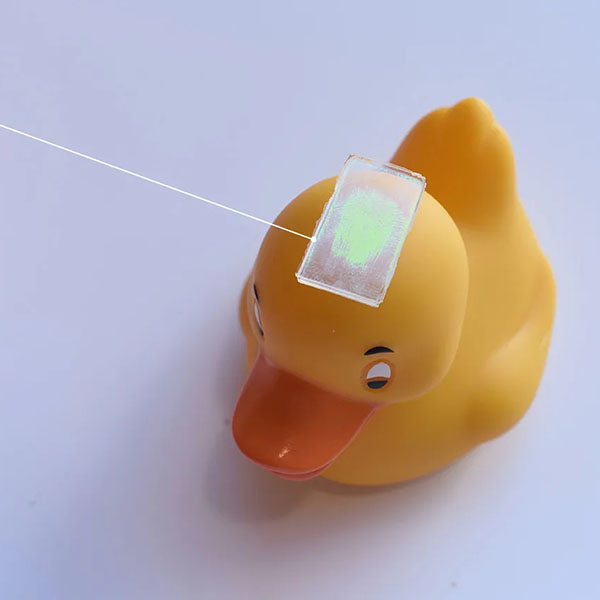
Detecting Toxic Chemicals with Low-cost, Color-changing Sensors
#ColorClear
Detecting Toxic Chemicals with Low-cost, Color-changing Sensors
#ColorClear

Research Terms
This process creates micropatterns in the nanostructure of smart polymers, forming films that help secure against counterfeiting. Over the past decade there has been a global increase in fraud and sale of counterfeit items, including unauthorized brand names. Due to this, the market for anti-counterfeit packaging and labels has grown, and analysts expect it to grow $106 billion by 2024 . The ability of shape memory polymers to retain unique patterns can enable various security measures against counterfeiting, tampering, or brand theft. However, most shape memory polymers configure using high temperature stimuli above ambient conditions, limiting their use for many applications.
Researchers at the University of Florida have developed a process to inscribe specific photonic crystal micropatterns into a nanostructured shape memory polymer film. Patterns, messages, or symbols imprinted in the nanostructure of the smart polymer are revealed under chemical stimuli, creating films useful for anti-counterfeiting and microchip security processes.
Smart polymer films using a photonic crystal nanostructure that hide and reveal micropatterns such as logos, symbols, or codes, for securing computer chips or brand products against counterfeiting
The process utilizes UV light and various solvents to inscribe micropatterns into the photonic crystal nanostructure of shape memory/smart polymer films. With nanostructure features smaller than 1mm, these micropatterns can serve anti-counterfeiting purposes, leaving symbols, logos, messages, or codes in the film. The photonic crystal inscription process also has the potential to contribute to the designs of photonic integrated circuits for high-speed electronics.
This chromogenic vapor sensor, utilizing a new type of shape memory polymer, shows a striking color change when exposed to different vapors. Commonly available vapor sensors work by monitoring the change in electrical properties of a conducting device; they are expensive, bulky, and inaccessible to the public.
Researchers at the University of Florida have developed a chromogenic vapor sensor that is reusable, inexpensive to produce, and easy to wear or hang in the field, making it perfect for quickly testing people or screening environments for harmful vapors, such as acetone, methanol, and dichloromethane. This vapor sensor is highly sensitive even to low doses and can improve wearable medical diagnostic screening, weapons detection, indoor air quality monitoring, and smart phone spectrometer applications.
Chromogenic vapor sensor that detects and characterizes different vapors for environmental monitoring, chemical processing, industrial manufacturing, or security operations
This chromogenic vapor sensor changes from colorless to strikingly iridescent when exposed to different vapors. The sensors are photonic crystal membranes with a 3D pattern of macropores that detect different vapors. This array of macropores has two states: a collapsed state and an inflated state. In the collapsed state, the vapor sensor is transparent, but when it transitions to an inflated state, the vapor sensor changes to an iridescent color that is visible to the naked eye. The transition occurs when the collapsed macropores encounter various vapors such as acetone, methanol, and dichloromethane. The vapor sensor will change to a certain color corresponding to the type of gas present based on Bragg diffraction of visible light. Different vapors lead to distinguishable colors, enabling specific detection of the vapors by simply monitoring the color change of the membrane.
These adhesive films utilize a microporous shape memory polymer to perform switchable, dry adhesion useful in situations requiring two or more levels of adhesion. Dry adhesives are part of the pressure-sensitive adhesives market, which analysts expect to reach $9.5 billion by 2024. Dry adhesive materials stick to surfaces without the use of any chemical substances, leaving no residue behind when removed. Such gecko feet-mimicking adhesives have many applications in cutting-edge technologies such as bionics, soft robotic fingers, and body-tissue interfaces, as well as in more common commercial products like wall hangers, bandages, labels, tapes, or automobile trim components.
Researchers at the University of Florida have produced dry adhesive films that exhibit different adhesion forces and are reusable. Manipulating the size and number of microscale pores in shape memory polymer films can vary their adhesive strength when applied to a surface. The pores can open and close in response to multiple external stimuli, allowing removal and replacement of the adhesive films.
Reusable dry adhesive films that can have multiple levels of adhesive force
These microporous shape memory polymer films perform switchable dry adhesion. Microscale pores in the polymer create an adhesive force dependent on their number, size, and whether they are open or closed. Putting the films in water and drying them closes the pores while putting them in ethanol opens the pores. Closed pores lead to weaker adhesion, and open pores lead to stronger adhesion. Depending on the necessary adhesion force, manufacturers can manipulate the microporous dry adhesion films using plasma-etching or some other processes to vary the roughness of the film’s surface. The crystal structure of the SMP films couples film adhesiveness with color so that a color change signifies a change in adhesion state.
This nanostructured coating forms an essentially black surface on crystalline silicon wafers, reducing the reflection of light off solar cells significantly to improve their efficiency. Analysts project the global market for solar panel coatings to reach $19 billion by 2026. The anti-reflective coatings segment is likely to dominate since low reflectance can boost a panel’s performance by increasing absorption capacity and light transitivity. Solar panels are known to be relatively inefficient, failing to capture the full potential of solar energy. Part of their inefficiency is due to the high reflectivity of crystalline silicon wafers, as reflected light cannot be harnessed for conversion into electricity.
Researchers at the University of Florida have developed an antireflective and superhydrophobic coating comprised of hierarchical silicon nanostructures. The coating would dramatically improve the efficiency of solar panels.
Anti-reflective silicon nanostructured coating that greatly improves the efficiency of solar panels as well as surface-enhanced Raman Scattering (SERS) sensors
Researchers have fabricated hierarchical nanocylinders on single-crystal silicon wafers for use in antireflection coatings, superhydrophobic surfaces, and surface-enhanced Raman scattering sensors. This nanostructured coating is non-reflective over the range 400 nm – 1100 nm. These wavelengths include all of the visible and near-IR light that a crystalline silicon solar cell can harness, thus tremendously increasing the absorption capacity and thereby the overall efficiency of solar power generation. The coating can be applied at the time of manufacture of new panels as well as to existing solar panels.
This chromogenic sensor uses shape memory polymer gratings to detect the concentration of ethanol in gasoline and other commercial liquid products. One of the most common uses of ethanol is as a fuel additive to reduce air pollution, and over 97 percent of all U.S. gasoline contains ethanol. However, ethanol has lower energy content than gasoline and corrodes aluminum and rubber components of fuel systems. Therefore many vehicles, such as aircraft and older automobiles, require gasoline with very low or zero ethanol content, leading to the necessity for easy, inexpensive tests for ethanol concentration. Although available electronic ethanol sensors are highly accurate, their high cost limits their market adoption rate. Other available ethanol tests, while having low cost, also have low accuracy and can only detect ethanol concentrations of around five percent or greater.
Researchers at the University of Florida have developed a low-cost, reusable, nonelectric chromogenic sensor that rapidly analyzes the concentration of ethanol in gasoline, drugs, or other liquid products. Users simply expose the sensor to a few drops of gasoline while a smartphone platform analyzes the color changes of the sensor to determine the ethanol concentration.
Inexpensive and user-friendly colorimetric sensors scalable for mass manufacture that detect ethanol concentrations in gasoline and other liquid products
These sensors detect trace concentrations of ethanol in liquid mixtures by giving off specific colors upon exposure to different concentrations. To fabricate a sensor, a commercial polyurethane monomer and photoinitiator mixture pours onto the grating structure of a common optical disc, such as a DVD. After rapid photopolymerization, the polymer detaches from the disc while maintaining the chromatic grating structure. A simple mechanical compression process then deforms the polymer grating structure into a temporary configuration. When contacted with a liquid containing ethanol, the deformed polymeric structure of the sensor, with no structural color, gradually recovers back to the memorized grating structure according to the liquid’s ethanol concentration, subsequently causing an easily-perceived color change. An accompanying smartphone platform analyzes the change in color to rapidly determine the precise concentration of ethanol in the examined liquid.
This glass coating composition uses nanoparticle self-assembly to generate a transparent, durable, and abrasion-resistant antireflection glass coating. Inexpensive antireflection coatings on glass substrates are of great industrial application in high-performance optics and optical devices for reducing unwanted reflection from the glass surfaces. Traditional glass surfaces are prone to losing some transmitted light to surface reflection, requiring antireflection glass coatings to prevent optical loss and image distortion. Additionally, it can increase the energy conversion efficiency of high-performance optics. Current antireflection coatings, usually prepared by vacuum-based physical vapor deposition technologies, like sputtering, suffer from high cost and low throughput. Scientists have explored some nanoparticle self-assembly-based antireflective coatings, such as the nonporous coating driven by phase separation and selective removal of spin-coated polymer blends, and the single-step monolayer nanoparticle self-assembly by the Langmuir-Blodgett technology. However, the technologies suffer from poor durability, are prone to abrasion, and can be easily scratched off the glass surface. These limitations are critical in final commercial applications, making durable and high-performing coatings necessary.
Researchers at the University of Florida have developed a nanoparticle-based antireflective coating for glass substrates, producing a more durable and abrasion-resistant glass coating than traditional bottom-up technologies. This composition marks a simple and inexpensive antireflection coating system for reducing light loss from optical reflection while generating high output quantities at any given time.
Nanoparticle-based composition for generating antireflection glass coating with improved durability and abrasion-resistance
University of Florida researchers developed an antireflection glass coating composition using self-assembling nanoparticles. Using silica nanoparticle spheres for coating vastly increases the amount of light that passes through coated glass surfaces, increasing the efficiency of use. The silica spheres are centrifugated and redispersed in pure ethanol to ensure the purification of the particles. By flash-annealing, the silica spheres melt and shrink slightly, creating a bond between the nanoparticles and between the nanoparticles and the glass substrate. This bond increases the durability of the coating without impacting its performance. The process generates an antireflective, durable, and abrasion-resistant glass surface. Additionally, using inexpensive and commercially available materials and equipment enables the generation of large amounts of coated glass surfaces within a short time span.
This anti-reflection coating reduces optical reflection and increases light transmission through geometrically complex optical surfaces. Consumer demand for anti-reflective properties continues to need for improved applications such as improving light conversion efficiency of solar cells, increasing transmittance of optical lenses, eliminating ghost images on flat-panel displays, reducing glare from automobile dashboards, to name a few examples. The global anti-reflection coating market should reach $7.5 billion by 2025. Available vacuum-based anti-reflection coatings are burdened by high costs, limited raw materials for manufacturing, and low light transmission. More importantly, coating nonplanar surfaces is challenging, which limits the scope of application for anti-reflection coatings. Available anti-reflection coatings are difficult to apply to curved or enclosed concave surfaces.
Researchers at the University of Florida have developed an efficient, effective system that applies uniform anti-reflection coatings to nearly any nonplanar surfaces. A uniform, single layer of silica nanoparticles applied to a surface through a simple self-assembly approach and then cured with vapor creates a durable anti-reflection coating covering both internal and external surfaces of the optical components.
Efficient, scalable process for applying a durable anti-reflection coating onto nearly any shaped surface, including those with complex geometries
An electrostatics-assisted, colloidal self-assembly process allows uniform nanoparticle anti-reflection coatings deposits onto geometrically complex optical surfaces. A single layer of negatively-charged silica nanoparticles adhere to a positively-charged surface to form the optical coating. The monolayer anti-reflection coating improves light transmission, through surfaces with various geometries, to more than 97 percent transmission for wavelengths between ~500 and ~800 nm. The addition of a simple vapor-treatment step enhances adhesion of the nanoparticles, significantly improving the strength and durability of the anti-reflection coating.
This surface texturing develops subwavelength antireflective nanostructures on the faces of single-crystalline and multicrystalline silicon wafers to produce black silicon suitable for highly efficient photovoltaics and semiconductor light emitting diodes (LEDs). With the growing desire for renewable energy sources, the global photovoltaics market is projected to exceed $345 billion by 2020. Crystalline silicon wafers are fundamental components of the solar cells used for photovoltaic energy harvesting. Since the high surface reflectivity of silicon wafers inhibits energy absorption by limiting the spectrum of usable light, crystalline silicon solar cells must apply antireflection coatings to ensure efficient energy production. Alternatively, black silicon wafers achieve superior anti-reflection by modifying the surface of crystalline silicon with nanoscale structures that enable effective energy absorption from the broadest range of visible and infrared light. However, available procedures for producing black silicon involve complex lithographic processes that limit the speed of production and increase overall costs.
Researchers at the University of Florida have developed a simple surface texturing procedure that forms a broadband antireflection coating directly on the surface of crystalline silicon wafers. The black silicon formation is non-lithographic and uses a scalable, self-masking etching process that involves only a single step to enhance mechanical and environmental stability.
Black silicon nanostructured crystalline wafers with high-antireflective performance that reduce all light within the spectrum from visible to infrared, improving the efficiency of photovoltaic conversion and light extraction for use in solar cells, semiconductor LEDs, or ultrasensitive biosensors
This nanoscale surface texturing of silicon wafers and other similar substrates establishes antireflective layers effective over a wide range of visible and infrared light. During a simple reactive ion etching (RIE) process, a polyimide substrate in contact with the wafer triggers a random distribution of micro-masks throughout the wafer, which results in the formation of random nanoscale pillars on the surface area not covered by the polyimide. Consequently, the surface of the wafer uncovered during this etching process demonstrates broadband antireflection performance superior to those formed by other surface texturing procedures.
This pressure-responsive polymer collapses when a small force is applied to it and quickly returns to its original shape when no longer compressed. The technology is useful for identity authentication systems. The Federal Bureau of Investigation (FBI) alone maintains the fingerprints of more than 100 million American citizens and new entries are added every day. Stored fingerprint images and fingerprint readers allow law enforcement officers and others to track individuals' security clearances and criminal activity. Proper fingerprint image acquisition is critical for later authentication.
Researchers at the University of Florida have developed a polymer that memorizes the shape of 3D objects, such as fingers' friction ridges (unique raised patterns of the epidermis). While in its collapsed state, the polymer is transparent. It changes color in response to pressure, providing visual proof that a high-quality fingerprint has been acquired. The technology can be adapted for other optical applications, such as anti-glare and anti-counterfeiting coatings.
A pressure-responsive polymer for improved fingerprint acquisition and recognition, which changes color when compressed
University of Florida researchers have developed a pressure-responsive polymer that changes color when compressed and memorizes the shape of any 3D object. The polymer is comprised of hydrogel-like macroporous membranes with highly ordered pores. The pores collapse under pressure and immediately recover when pressure is alleviated. In its compressed state, the polymer is transparent due to the collapsing of the pores. In the locations of pressure, the film recovers its 3D structure and becomes iridescent. It shows a rainbow of colors at the points of pressure due to the Bragg diffraction of visible light from the 3D ordered crystalline structure.
This tunable, anti-reflection coating uses a variety of shape memory polymers with a nanoporous structure to help regulate light transmission and reflection in monitors, car dashboards, optical lenses, smart devices, solar cells and more. By 2020, the global anti-reflective coatings market will be worth more than $4.9 billion. The development of many smart devices precipitates the need to develop responsive optical coatings that can regulate light transmission and reflection. However, available tunable, anti-reflection coatings require tedious layer-by-layer self-assembly of polyelectrolytes, and depend on aqueous solutions to enable tuning. Researchers at the University of Florida have developed a coating with a nanoporous monolayer that can be fine-tuned even after the anti-reflection coating is fabricated. This technology facilitates anti-reflection in both liquid solvents and air and is enabled by a simple and scalable nanoparticle self-assembly platform, greatly expanding its manufacturability and application.
Tunable, anti-reflection coatings using various shape memory polymers with a broad thermomechanical range for application in regulating light transmission and reflection for products such as smart windows, brightness-adjustable displays and optical lenses
By using a simple and scalable Langmuir-Blodgett method, University of Florida researchers created a self-assembled silica nanoparticle monolayer and used it as a structural template for making nanoporous polymer membranes with anti-reflective properties. Structural manipulation at ambient conditions tunes the optical reflection of the shape memory polymer membranes. In its original state, the nanoporous structure provides a low optical reflection of light. When distorted, it shows high optical reflection. The shape memory polymers used have broad thermomechanical properties, exhibiting “cold” programming behaviors. This allows them to deform and recover repeatedly, changing to a highly reflective state back to the original state, at ambient conditions with no sign of degradation after hundreds of cycles, quite different from traditional thermoresponsive shape memory polymers. In addition, the tunable, anti-reflection operations can occur in both air and in solvents.
This surface coating uses a graphene-oxide-reinforced shape memory polymer that changes color in response to laser beam. The early detection of a laser beams is desirable to prevent damage to military equipment, such as drones, that can lose functionality from laser beam illumination. Available technologies use multilayer dielectric mirrors or expensive metamaterial-based coatings. Both the U.S. military and commercial flight industries could benefit from a material that is free from electric current and can be coated onto large areas.
Researchers at the University of Florida have developed a smart coating that automatically responds to a broadband of laser illumination, from ultraviolet to near-infrared. Once triggered, the coating transforms into a highly-reflective state that reflects back most of the laser power. The shape-memory properties of this new type of smart coating enable the material to remember the laser’s trajectory, generate patterns and make it reusable.
A coating for application to large-scale surfaces that transforms into a highly-reflective state, after triggering from laser beam illumination, to reflect back the damaging laser beam
This smart coating comprises a synthesized black graphene oxide-shaped memory polymer nanocomposite. Self-assembled silica particles attach to a glass microslide and arrange into a sandwich-like structure. A viscous oligomer mixture, consisting of a shape memory polymer, graphene oxide and photoinitiator fills the space inside the sandwich structure and goes through polymerization by exposure to UV light. The newly formed membrane detaches from the microslide and soaks in an acidic aqueous solution, removing the silica particle layer and creating a porous structure.Deionized water and ethanol rinse the final product and leave it with a greenish diffractive color. This reconfigurable photonic crystal coating activates from laser beam illumination at multiple wavelengths, dissipates their energy, and returns to its original color by cold programming. This feature allows the technology to serve as a defensive and protective application for military weaponry against laser beams light.
These self-cleaning, antimicrobial nickel-titanium surfaces enable corrosion-resistant, biocompatible, and antimicrobial performance while preserving shape-memory actuation for biomedical and industrial applications. Nickel-titanium shape-memory alloys are widely used in minimally invasive medical devices, implants, aerospace components, and industrial systems because of their unique shape memory and super-elastic properties. The global market for shape memory alloys was valued at $11.2 billion in 2024 and is projected to reach $28.7 billion by 2034, reflecting a robust compound annual growth rate (CAGR) of 10.1%. However, long-term performance is often compromised by corrosion, biofouling, contamination, and fluid-induced drag. Conventional hydrophobic coatings generally suffer from poor durability, can degrade under mechanical deformation, or interfere with the functional properties of NiTi substrates. Therefore, an urgent need for improved surface treatment methods for next-generation applications is evident.
Researchers at the University of Florida have developed a self-cleaning, superhydrophobic, antimicrobial surface coating for nickel-titanium shape memory alloys, which provides corrosion-resistant, biocompatible, and antimicrobial performance while preserving shape memory actuation for biomedical and industrial applications. The treated surfaces exhibit water contact angles ranging from 150° to 180°, enabling strong water repellency, antimicrobial, and self-cleaning behavior. By preserving the shape memory and super-elastic properties of nickel-titanium shape-memory alloys, the coating makes these devices ideal for applications where both mechanical adaptability and surface cleanliness are essential.
A self-cleaning, superhydrophobic nickel-titanium coating that delivers corrosion-resistant, biocompatible, and antimicrobial performance while preserving shape memory actuation for biomedical and industrial devices
This self-cleaning, superhydrophobic nickel-titanium coating delivers corrosion-resistant, biocompatible, and antimicrobial performance while preserving shape memory actuation. The process starts with a thin template of silica microspheres deposited on the nickel-titanium surface. These microspheres form a hexagonally packed layer that guides the creation of a dual-pore structure during chemical etching. The resulting hierarchy of tiny circular pores nested inside larger pits creates the air-trapping surface essential for water-repellent behavior. After etching, the surface is treated with a fluorinated silane compound and heat-cured to lock in its superhydrophobic properties. The finished nickel-titanium surface exhibits contact angles between 150° and 180°, so water droplets bead and roll off easily. This superhydrophobic effect significantly reduces fluid drag, enabling self-cleaning and antimicrobial capabilities even under high-flow conditions.
This thin film material combines the characteristic shape-memory behavior of heat-responsive alloys with tunable optical properties. Shape memory alloys are materials that can be contorted at low temperatures yet inevitably return to their original shape after a single heating/cooling cycle. Such predictable, heat-activated shape changes make them attractive for actuators and other devices that convert energy into mechanical motion. The global market for smart materials with motor or actuator applications was over $10 billion in 2010 . While shape memory alloys have traditionally been studied for their mechanical performance, interest in their optical properties has grown due to emerging opportunities in plasmonics, sensing, and nano-optics. Accordingly, demonstrations of alloys whose shape memory controls useful optical effects are needed.
Researchers at the University of Florida have developed a nickel-titanium thin-film shape-memory alloy that exhibits iridescence and surface plasmon resonance when nanostructured. These useful light-matter interactions can then be turned off simply by heating the material, thereby triggering a shape-memory-effect transition that restores the material to its original geometry. This cycle between different optical behaviors can be repeated indefinitely.
Smart materials and devices that undergo reversible changes in both shape and optical properties in response to heat
The atoms that form certain materials, such as metals and metal alloys, arrange themselves in repeating patterns known as crystals. In most cases, the same material can form different crystals under different conditions, such as temperature and pressure. Shape memory alloys intelligently navigate these transitions, returning to their original form after deformation. This nickel-titanium alloy forms a smooth, shiny sheet in its original form, martensite. Applying several thousand pounds of pressure to give the alloy a nanostructured shape induces a phase transition known as detwinning, which renders it colorfully iridescent. Strikingly, the alloy readily reverts to its original shiny sheet form when heated just above room temperature (60 °C) due to a heat-driven transition from detwinned martensite to austenite. This linking of distinct reflective properties to the two crystals exhibiting the shape memory effect yields improved nano-optical devices, such as light-emitting diodes and plasmonic biosensors. Plasmonic biosensors rely on a light-matter interaction known as surface plasmon resonance that can detect viruses infecting the body. Notably, surface plasmon resonance is enabled in the nanostructured state but absent in the recovered smooth state. This capability makes it attractive for applications in plasmonic biosensors, nano-optical devices, and advanced sensing platforms.
This bioinspired black nickel coating employs moth-eye gratings on silicon as structural templates, dramatically exhibiting ultra-low light reflection. Black nickel coatings are widely used for electrodes, solar cells, electrolysis systems, and catalysis. Antireflective coatings are extensively used in numerous applications across various industries. Researchers have drawn inspiration from unique nanostructures found in living organisms such as the eyes of moths and wings of cicadas to fabricate antireflective nanostructures on metal surfaces. These biological surfaces possess ordered hexagonal arrays of nanoscale features that effectively suppress light reflection. Compared with conventional surfaces, moth-eye nanostructures provide a large specific surface area and can effectively enhance photoelectric conversion efficiency.
Researchers at the University of Florida have developed a bioinspired black nickel coating that exhibits ultra-low light reflection while providing a substantially increased surface area. Additionally, these coatings can be applied in electrodes, electrolysis, and photocatalysis. The resulting black nickel films demonstrate significantly enhanced electrocatalytic activity toward hydrogen evolution reactions (HER) and oxygen evolution reactions (OER), creating opportunities in renewable energy, electrochemical manufacturing, and sustainable technologies.
Bioinspired black nickel coatings exhibit ultra-low light reflection across a broad range of visible and near-infrared (IR) wavelengths, making them attractive for photovoltaics, photocatalysis, electrochemical energy conversion, and advanced optical devices
Black metal films with low light reflection are of major technological importance in many applications, for example, efficient electrode materials for solar cells, photocatalysts, and electrochemical devices. Researchers at the University of Florida have developed a fabrication technique for black nickel coatings inspired by the nanostructure of a moth’s eye. Moth eyes have a unique antireflective coating, reducing light reflection to nearly zero. Their eyes have a thin, non-tightly packed layer of hexagonal arrays of nanostructures on the surface of their eyes, with heights and spacings below 300 nm. The arrays of the surfaces create a gradual transition of reflective index from the surface to the air, reducing reflections over a broad range of wavelengths and angles of incidence. The resulting black nickel coatings exhibit ultra-low light reflection and substantially enhanced surface area, enabling improved optical and electrocatalytic performance.
These chromogenic photonic crystal sensors enable real-time plasticizer safety testing by instantly detecting toxic plasticizers through a visible color-changing response. Polyvinyl chloride (PVC), the world’s third-most produce synthetic polymer, is widely used in everyday life, such as food packaging films and containers, window frames, fake leather car seats, children teething toys, and medical products. Toxic plasticizers are added in large quantities, about 10 million tons worldwide in 2024, to PVC and other plastics for improved flexibility, durability, and malleability. Yet, the colorless and odorless nature of the plasticizers allows them to migrate out of plastic products, contaminating the contact air, liquids, and solids. This can lead to health implications, including asthma, allergies, autism, and various cancers.
Available ways to identify and quantify plasticizers rely on costly, sophisticated instrumentation, making routine, on-site testing impractical. Existing colorimetric sensors are cheaper and easier to use but typically require immersion in the analyte and generate only a transient color shift that disappears once the stimulus is removed. With the global plasticizer market exceeding $18 billion annually and increasing consumer demand for non-toxic plastics, there is a need for a low-cost, rapid method that delivers a permanent visual signal for real-time, on-site testing.
Researchers at the University of Florida have developed chromogenic photonic crystal sensors for real-time plasticizer testing by instantly producing a visible color change when plasticizer contamination is present. These sensors represent a new-generation of colorimetric materials for detecting toxic plasticizers at solid–solid interfaces, revealing phthalate diffusion from PVC toys and films within seconds, with no false-positive responses in cleaned samples. It provides a simple, rapid, and visual readout that can be seen with the naked eye or with a smartphone camera.
Rapid, visual detection of toxic plasticizer migration in plastics and consumer products, providing solutions for quality control, environmental monitoring, regulatory compliance, and product safety testing
This class of chromogenic photonic crystal sensors introduces shape memory polymer materials for visually detecting small-molecule diffusion at solid–solid interfaces. The sensors operate by embedding ordered photonic crystal structures within flexible polymer matrices that can reversibly change configuration upon chemical exposure. When plasticizers such as phthalates migrate out of polyvinyl chloride (PVC) surfaces, they diffuse into the sensor’s macroporous network and relax the compressed polymer chains, restoring the ordered lattice responsible for vivid structural color. This transition from a transparent to an iridescent state directly signals chemical migration without the need for spectroscopy or electronic readout. These properties establish the material as a practical, low-cost platform for real-time detection of toxic contaminants in consumer and industrial plastics.
This bio-compatible pressure-sensitive hydrogel coating applied to or embedded in existing ocular implants provides direct and continuous measurement of intraocular pressure. Ophthalmologists measure intraocular pressure to diagnose and treat eye diseases such as glaucoma, ocular hypertension or hypotony. However, available ocular pressure measurement methods don’t directly measure internal pressure, but instead involve external contact with the eye to approximate the pressure inside the eye. Likewise, available contact lenses that measure pressure require calibration both before and after placement, require power and data transmission, can cause discomfort when worn, and return variable results based on the physical properties of a patient’s ocular wall.
Researchers at the University of Florida have developed a bio-compatible material to coat onto or embed into ocular implants, such as intraocular lenses or glaucoma drainage tubes, placed into the eye for numerous clinical reasons. This pressure-responsive hydrogel changes color in response to different pressure levels, allowing qualitative monitoring by spectral analysis using currently available smartphones and apps. Therefore, patients and medical professionals can rely on this smart material for an effective non-contact method of direct intraocular pressure measurement throughout the day.
Pressure-sensitive, chromogenic, bio-compatible hydrogel for ocular implants to directly measure intraocular pressure
This material uses chromogenic photonic crystals that change color depending on the level of pressure exerted onto the lens inside the eye. Different hydrogel colors can directly correlate to various ranges of interocular pressure: normal (about 10 - 20 mm Hg), elevated (about 20 - 30mm Hg or more) and reduced (about 4 mm - 10 mm Hg or less). Manufacturers of ocular implant devices, such as drainage stents, tubes, intraocular lenses or prosthetics could apply the coating or incorporate it onto any component of the implant. Once implanted, practitioners can then observe the color of the pressure-sensitive hydrogel by using an ophthalmoscope or otoscope. Additionally, practitioners can monitor the color by spectral analysis, using a handheld spectrometer, or other generally available device, combined with a smartphone app. Either way, this hydrogel allows continuous, direct, and noninvasive ocular pressure monitoring without the need for dilation or external contact with the eye.
This reusable, chromogenic ethanol sensor can detect the concentration of ethanol in a single drop of gasoline. Ethanol has lower energy content than gasoline; it also can cause corrosive damage to rubber and aluminum components of fuel systems. Available methods for testing ethanol concentration involve the addition of water and observing the volume change caused by selective absorption. However, this method has low accuracy and can’t be used when the ethanol content is lower than about 5 percent volume. Alternatively, electronic sensors on the market can precisely analyze the concentration of ethanol in gasoline, but the cost is prohibitive.
Researchers at the University of Florida have created a reusable, chromogenic ethanol sensor that is inexpensive, is easy to operate, requires only a small amount of gasoline for testing and produces results that can be easily distinguished by the naked eye. These sensors can be used to test ethanol concentration in other healthcare products, such as antiseptics and liquid drugs.
Chromogenic films capable of detecting ethanol concentrations in gasoline and other healthcare products
These reusable chromogenic ethanol sensors are able to detect trace amounts of ethanol in fuel grade gasoline and other commercial products. The sensors are composed of a tunable polymer membrane created through simple, scalable, nanoparticle self-assembly technology. The polymer membrane has a macroporous structure that is designed to respond specifically to ethanol. When exposed, the macropores alter in shape, producing a chromogenic color change. The varied concentration of ethanol produces drastically different colors, allowing unaided eyes to interpret the results. The membrane will return to its original color through cold programming and can be reused. Additionally, a mobile smartphone platform can quantitatively analyze the ethanol concentration.







DEPARTMENT OF CHEMICAL ENGINEERING PO Box 116005 PO BOX 116005 GAINESVILLE, FL 32611-6005



