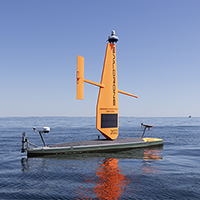
A USF team is working with Saildrone to deploy two types of autonomous vessels simultaneously for seafloor mapping. Multibeam sonar is typically used to estimate water depth, but because sound waves refract underwater, such estimates have limited reliability. However, water properties such as temperature and pressure can change how fast sound waves travel. These fluctuations, or sound speed profiles, can be used to correct the refraction of acoustic pulses from multibeam sonar.
Saildrone’s vehicles gather data from the surface while USF gliders dive to collect vertical profiles. Comparing data from the two methods may lead to more accurate sound speed forecasts. “The observations collected by both gliders and Saildrone USVs are limited in location,” says USF’s Yonggang Liu. “By feeding the new data into the West Florida Coastal Ocean Model … we can use the real observations to evaluate and improve model simulation.”
View Related Expert Profiles: Go to Source