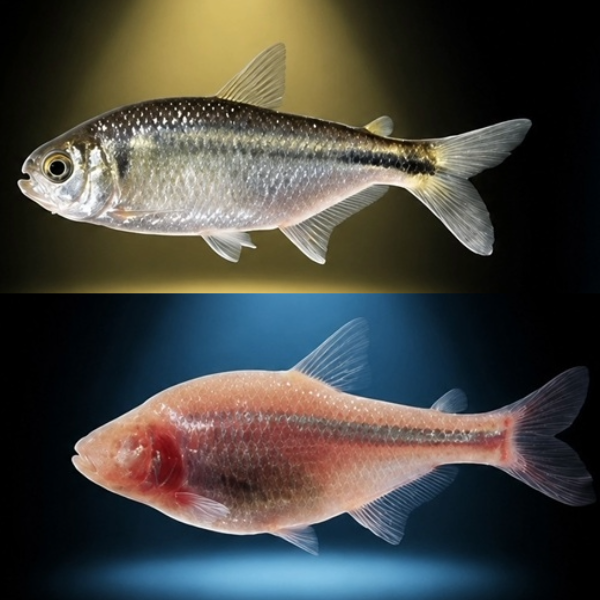
A team including FAU’s Erik Duboué compared visual neural activity in the blind, cave-dwelling form of the Mexican tetra and the sighted, surface form of the same species. The researchers used a combination of behavioral experiments and whole-brain imaging to track how different brain regions responded when the fish were exposed to light and darkness.
They found that brain activity in the surface fish increased in darkness, likely helping them search for light, while the brains of the cave fish became more active in light, perhaps helping them avoid predators. The team identified changes in a region known as the posterior tuberculum, as well as a previously unrecognized neuronal cell type linked to these behaviors. “Neurons that respond to darkness in surface fish were found to respond to light in cavefish, suggesting that evolution can repurpose existing neural circuits rather than creating entirely new ones,” says Duboué.
View Related Expert Profiles: Go to Source