
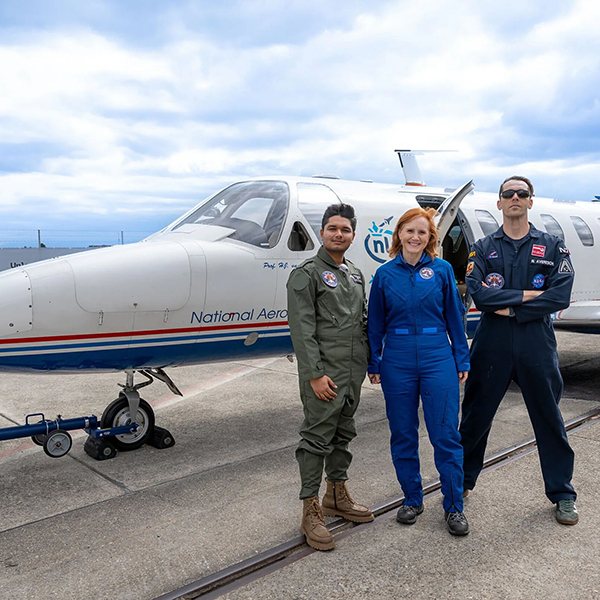
A team of UF researchers are studying the effects of microgravity on human cells. The team took their experiments 30,000 feet in the air on parabolic flights to achieve this. These parabolic flights rapidly ascend and descend to create brief periods of free-fall which simulate weightlessness.
“In microgravity, the cells grow in a more uniform, three-dimensional structure. Fluid dynamics are fundamentally different without buoyancy and convection, and the stress of microgravity can change the signals cells produce,” says Siohban Malany. “We are studying whether those changes can help us generate extracellular vesicles with stronger biological properties and ultimately develop a new approach to treating heart and muscle diseases.”
View Related Expert Profiles: Go to Source
